Is TikTok Shop in the US Becoming Douyin? The Better Comparison Is China in 2018
Direct answer: US TikTok Shop is starting to resemble Douyin, but not the mature Douyin most people see today. Its creator-led sales mix, emerging merchant tools and still-small LIVE contribution look closer to Douyin around 2018, when short-video commerce was taking shape. The useful lesson is therefore not to copy today’s China playbook, but to understand the sequence through which content, creators, paid traffic and livestreaming become a commerce system.
I started working with Douyin in 2018.
That year matters. Shopping-cart links were still being tested with a limited group of creators. Xingtu, Douyin’s official marketplace connecting brands with creators, was rolling out. Livestream commerce existed, but it had not yet become the sales engine it would later become.
Eight years later, on 21 August 2026, I heard a familiar pattern from TikTok for Business speaker Xiaoyu Bian (边晓宇) at the Third China Beauty Globalisation Conference in Shanghai.
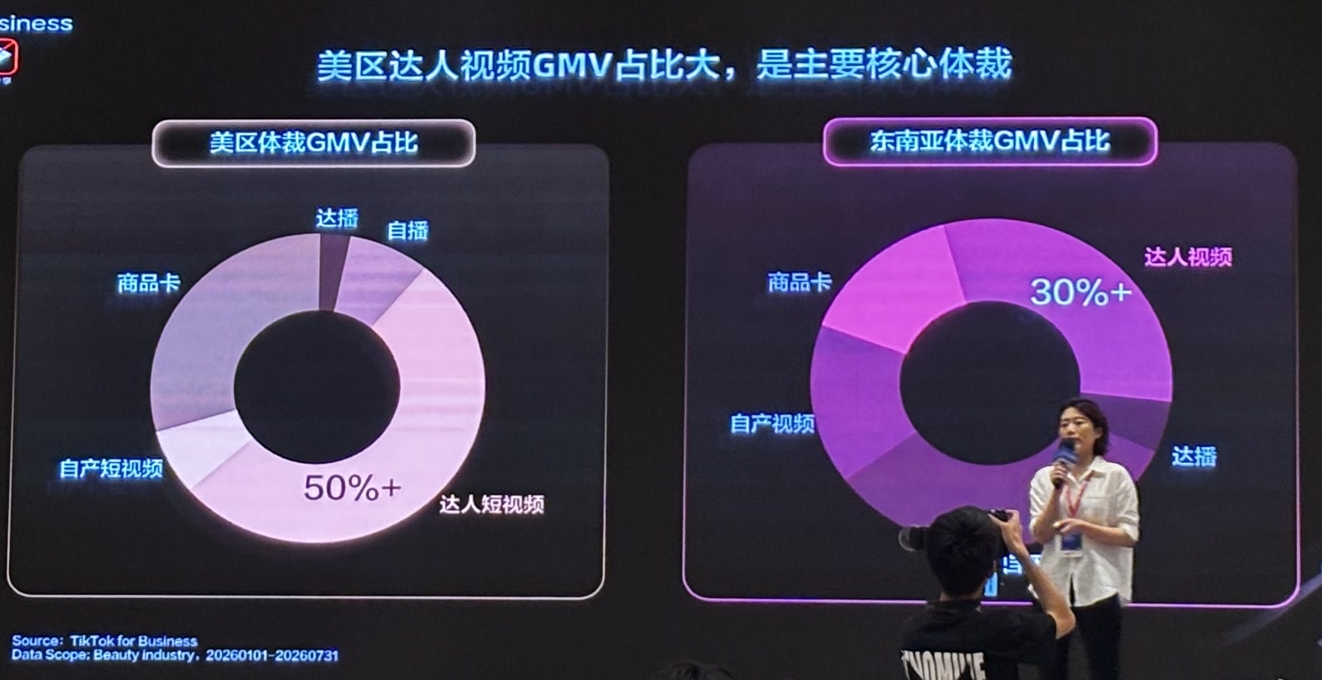
In US beauty, creator short videos generated more than 50% of TikTok Shop GMV between January and July 2026. Creator videos, not brand livestreams, were the centre of the commercial model. Merchants were learning how to recruit creators at scale, organise commissions, produce enough content and use paid tools to amplify the assets that worked.
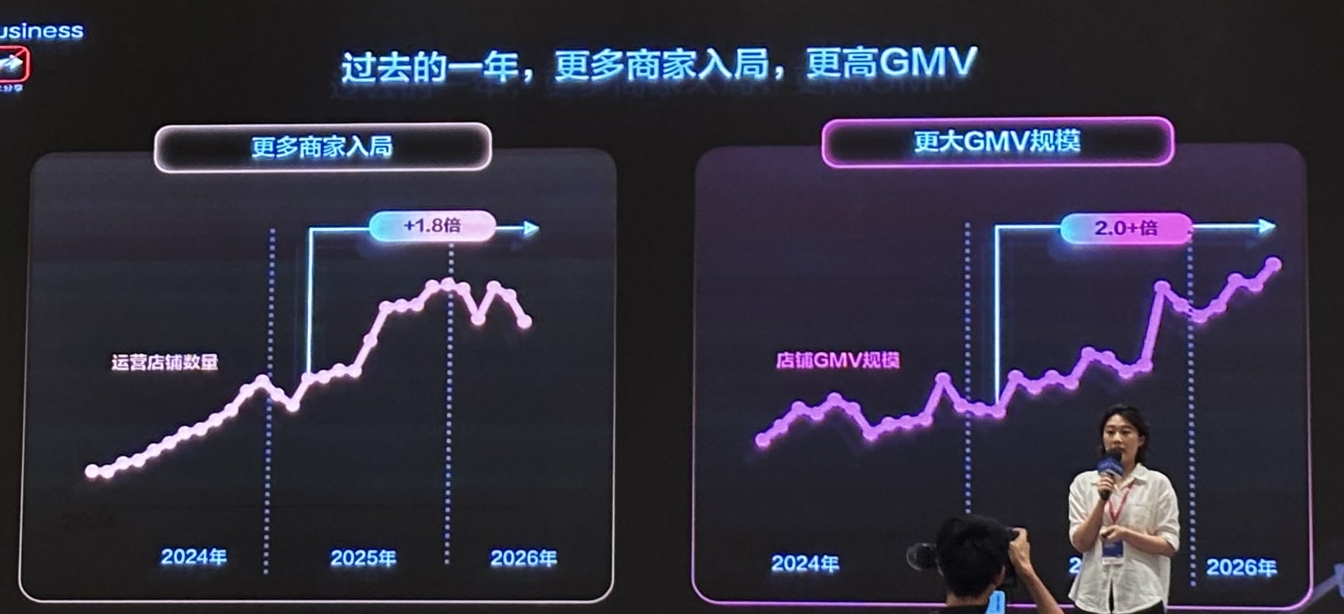
This was not a small experiment. TikTok’s presentation showed US beauty GMV growing by more than 70% year on year, with double-digit month-on-month growth in 2026. Over the previous year, it reported a 1.8x increase in operating shops and a 2.0x-plus increase in shop-level GMV. During the spring promotion, GMV reached 1.8 times the business-as-usual level.
This does not mean TikTok Shop in the US will follow Douyin step by step. The two markets have different consumers, creator cultures, logistics, regulations and retail structures.
But it does mean that comparing US TikTok Shop in 2026 with mature Douyin in 2026 can lead brands to the wrong operating plan.
The better comparison is Douyin in 2018.
Why the 2018 comparison is structurally useful
The resemblance is not about interface design. It is about where commerce value is being created.
| US TikTok Shop beauty, 2026 | Douyin around 2018 | What the stage tells brands |
|---|---|---|
| Creator short videos contribute more than 50% of GMV | Short video was the main commercial content format; livestream selling was still experimental | Build a creator-content engine before building a large LIVE operation |
| TikTok One is becoming a core tool for finding and managing creators | Xingtu was introduced to formalise transactions between brands, MCNs and creators | Creator recruitment is becoming infrastructure, not an occasional campaign task |
| Shops are building teams, commission structures and repeatable workflows | Brands were just learning how to organise accounts, creators, content and conversion | Early advantage comes from operating speed and learning loops, not only media budget |
| Paid automation such as GMV Max can scale brand and affiliate content | Douyin was rapidly connecting content distribution with commercial tools | Paid traffic becomes more powerful once a brand has enough proven content to feed it |
There is an important correction to the usual Douyin timeline here. In March to May 2018, shopping carts and creator storefronts were still limited tests. This was not yet the closed-loop Douyin e-commerce system brands know today. The point of the comparison is precisely that the system was incomplete — but its direction was becoming visible.
That is where US TikTok Shop appears to be now: beyond experimentation, but not yet at the mature operating model.
Do not copy mature Douyin into an earlier-stage market
In my 2025 book, Douyin Ecosystem: From 0 to 1, I used a 70% livestream / 30% short-video split as a planning reference for a sales-led Douyin programme.
That reflected the structure of a much more mature Chinese commerce ecosystem. By then, Douyin had trained hosts, specialised agencies, established livestream rooms, developed supply chains, familiar shopping behaviour and years of platform education behind it.
Applying that split directly to the US today would import the cost structure of a mature market without the infrastructure that makes it work.
For many US beauty brands, the starting point should be reversed:
- Build a wide creator pipeline.
- Find the product-message combinations that repeatedly convert.
- Use paid media to scale proven content.
- Add or expand LIVE when the offer, host, traffic and unit economics can support it.
This is not an argument against livestreaming. It is an argument about sequence.
Douyin’s history shows that LIVE becomes powerful after the surrounding system is ready. Treating it as the first answer can leave a brand paying for a room, a host and traffic before it has learned what customers actually want to hear.
The “best creator tier” changes as a shop grows
Brands often ask whether they should work with top, mid-tier or long-tail creators.
The TikTok session showed why that question is too static.
One growth case moved from T2 in March 2025 to T5 in January 2026 — roughly ten months. The presentation defined the stages by daily GMV: about US$65,000 at T2, US$200,000–500,000 at T4 and more than US$600,000 at T5.
The required content engine grew with it:
| Shop stage | Daily GMV benchmark | New paid creative assets per day | Typical creator commission | Creator structure |
|---|---|---|---|---|
| T2 | About US$65K | 10+ | About 10% | 75% of partnerships were long-tail, yet top creators generated 77% of GMV |
| T4 | US$200K–500K | 30+ | About 12–15% | Top creators still led GMV; mid- and long-tail creators increasingly supported scale |
| T5 | US$600K+ | 300+ | Around 20% or more | 79% of partnerships were long-tail and only 2% were top-tier; the speaker described top creators as support rather than the whole sales engine |
These are benchmarks from the case shown, not universal requirements. But the direction matters. At the beginning, a recognised creator can provide trust and concentrate conversion before the brand has built enough proof of its own. Long-tail creators provide volume, variation and learning, but many individual assets will not sell.
As the shop matures, the brand accumulates winning messages, social proof, creator relationships and retargetable demand. The portfolio can broaden, and the brand becomes less dependent on a few top creators for every transaction.
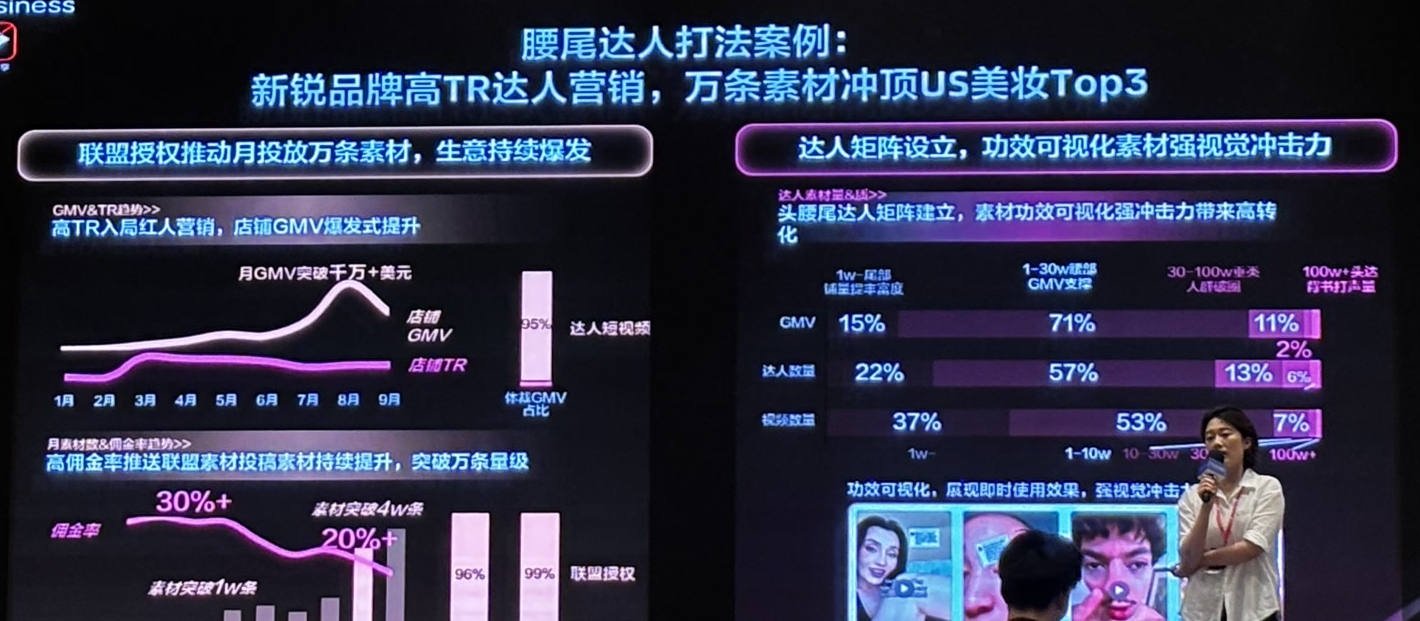
A second case showed what that broader portfolio can look like. For an emerging brand that reached the US beauty Top 3, creators with 10,000 to 300,000 followers accounted for 57% of creator partnerships and 53% of video volume, but generated 71% of GMV. Creators with more than one million followers represented 6% of partnerships and generated only 2% of GMV in that specific case. This is a case result, not a market-wide rule.
Two growth routes were also presented:
- A commission-led route that used a broad base of mid-sized creators first, took more than six months, and traded speed for lower upfront talent cost.
- A head-creator or celebrity-led route that created the first wave of attention, then let mid- and long-tail creators extend it, reaching the same broad destination in about three months.
The end state was similar. The cash-flow profile was not.
That gives brands a more useful choice: are you using money to buy time, or time to reduce the amount of money required upfront?
Paid conversion cannot replace demand creation
US TikTok Shop is already building powerful harvesting tools.
TikTok describes GMV Max as a system that combines brand-owned, organic, affiliate and paid content, then optimises it for total shop GMV. At the Shanghai session, advertised products showed seven times the average GMV of products that were not advertised. The average time to reach breakout performance fell from 34 days to 23 days, and 85% of products in the dataset were using paid promotion.
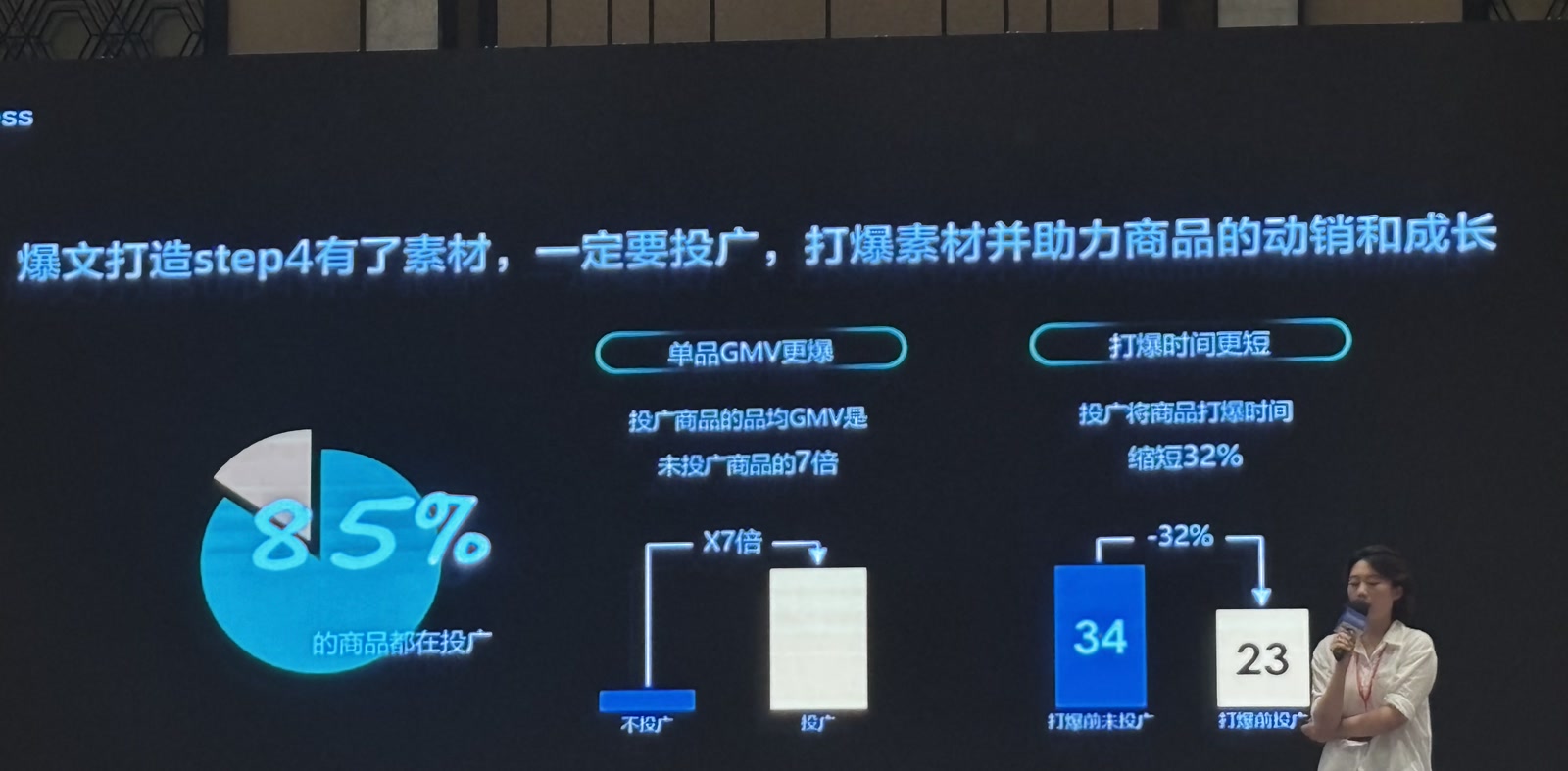
Those numbers make a strong case for amplification. They do not make a case for skipping demand creation.
The same deck showed why creator content is the input, not a decorative extra. Fifty-five per cent of users said creators influenced their interest in a brand. When creator content was amplified, the comparison shown delivered a 32% lower CPM and a 73% higher six-second completion rate than non-amplified creator content.
The clearest statement came from Xiaoyu Bian: conversion tools can move people who already show intent closer to purchase, but they struggle to turn a completely unaware audience directly into interested shoppers.
In plain language, the algorithm can harvest demand more efficiently than it can invent demand from nothing.
That gap still has to be filled by creator content, product storytelling, repeated exposure and social proof.
The same principle is visible during major promotional periods. In the session data, promotion-period GMV reached twice the business-as-usual level. Promotional days increased from 16% to 20% of the calendar, while their share of business doubled from 11% to 22%.
Promotions can concentrate demand. They cannot create a durable customer pool on their own.
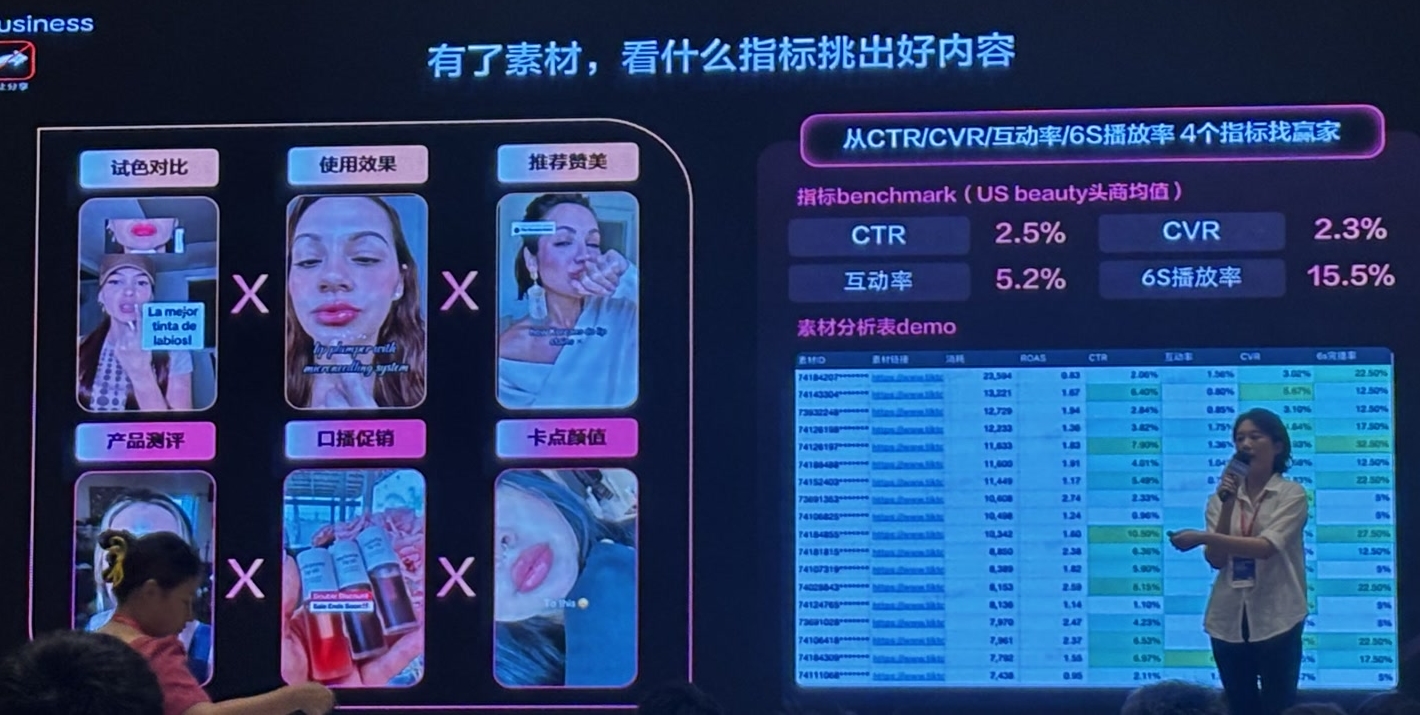
The presentation also offered four US beauty top-merchant averages for judging creative quality: 2.5% CTR, 2.3% CVR, 5.2% engagement rate and a 15.5% six-second view rate. These are mature-shop reference points, not cold-start minimums. Using them without that stage qualifier would turn a useful benchmark into a misleading entry bar.
Cross-cultural creator work is not a translation task
This is where a China-to-US comparison can become dangerous.
At the 21 August session, Xiaoyu Bian noted that US creators often replied more slowly and at a lower rate than creators in China. Her practical advice was to send more than a written brief: provide reference videos, sample scripts and specific language that makes the expected output easier to understand.
To preserve the commercial logic without forcing a Chinese script onto an American creator, a useful cross-border brief needs four layers:
| Layer | What the brand should provide |
|---|---|
| Commercial job | Is this asset meant to create awareness, answer an objection, demonstrate the product or close a sale? |
| Cultural reason | Why would this proof point feel credible to this audience? Which China-specific assumption must be removed? |
| Creative evidence | Reference videos, visual cues, product demonstrations and examples of acceptable claims |
| Room to adapt | The non-negotiable message plus the elements the creator can rewrite in their own voice |
What US beauty brands should do now
1. Build creator operations as a permanent capability
Creator commerce requires recruitment, sampling, briefing, follow-up, rights management, commission design, content review and performance tracking. It cannot sit inside a campaign calendar as a once-a-quarter activation.
2. Choose your route to scale deliberately
A top creator can compress the learning and trust-building period, but requires more cash and creates concentration risk. A wider base of smaller creators reduces dependency and produces more learning, but takes longer. The right answer depends on runway, margin and launch timing.
3. Measure creator roles by stage
Track creative volume, response rate, posting rate, usable-asset rate, GMV contribution and paid scalability separately. A creator who does not generate large direct GMV may still produce the asset that becomes the brand’s best paid ad.
4. Treat GMV Max as a multiplier
Feed paid automation with proven organic and affiliate assets. Do not ask it to compensate for a weak product message or an empty creator pipeline.
Frequently asked questions
Is TikTok Shop in the US the same as Douyin e-commerce?
No. The platforms share an origin and some commerce mechanisms, but their consumer behaviour, creator cultures, logistics, regulations and retail structures are different. US TikTok Shop currently resembles an earlier stage of Douyin more than its mature model.
Why compare US TikTok Shop in 2026 with Douyin in 2018?
Both stages are creator-video-led, with official creator marketplaces becoming normal and merchants still building repeatable operating methods. In 2018, Douyin shopping tools were emerging while livestream commerce remained small. That structural position is more useful than comparing the US with today’s livestream-heavy Douyin.
Should a TikTok Shop brand start with creators, LIVE or paid advertising?
For many beauty brands, the safer sequence is creator content first, paid amplification second and LIVE expansion once the offer and economics are proven. The exact mix depends on category, margin, creator access and how much time the brand can afford to spend learning.
Can a Chinese Douyin playbook be copied into the US?
The commercial sequence can be transferred, but scripts, creator management, incentives, compliance, logistics and consumer proof must be rebuilt for the local market. The objective is to transfer the logic, not the surface tactics.
What to do next
Aquarc helps global brands understand and operate inside fast-moving platform ecosystems — from China market entry on Douyin, Xiaohongshu (RedNote) and WeChat to cross-border growth questions where China’s experience can shorten the learning curve.
If your team is deciding what to copy, what to rebuild and what to ignore, contact Aquarc for a growth review.
If you want the operating foundations behind the China side of this comparison, read Bonnie Ma’s Douyin Ecosystem: From 0 to 1 on Amazon.